
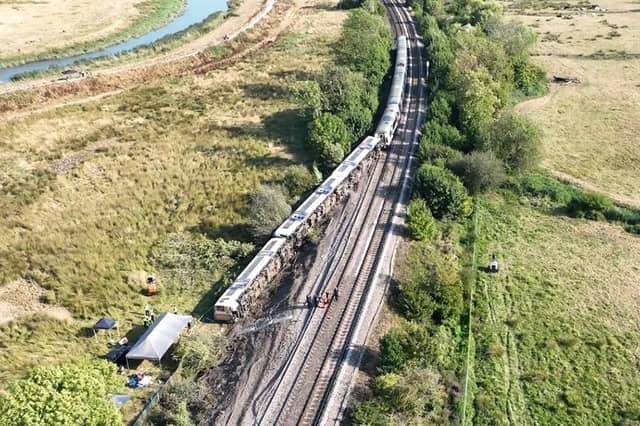

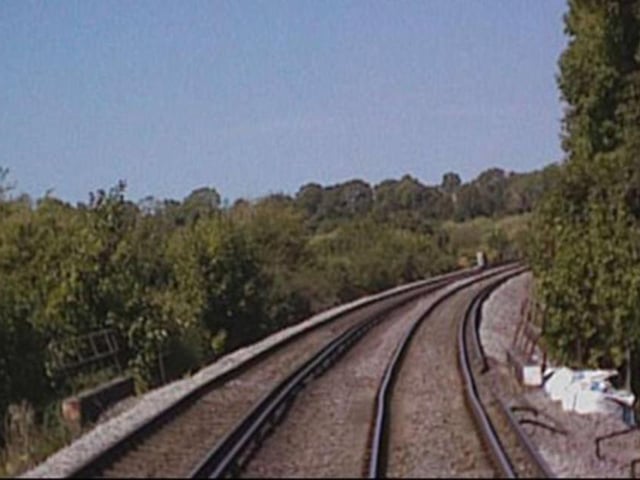
An interim report by the Rail Accident Investigation Branch (RAIB) published today (Wednesday, August 19) said CCTV images obtained from preceding services using these lines show a ‘track geometry irregularity’ on the immediate approach to the point of derailment, prior to the accident occurring.
There was also evidence of previous track maintenance activity in this area, the report says.
Following the accident, RAIB says it has received several reports of ‘rough riding’ at the location of the derailment from passengers on other trains. RAIB says it continues to analyse evidence relating to the derailment sequence and the status of the track.
The report also says the accident took place during ‘a sustained period of hot and dry weather’ with the temperature at the time being around 27 degrees Celsius. It said the embankment on which the railway runs at the location is made of clay and sits on alluvial/alluvium deposits (consisting of loose clay, silt, sand and gravel). It says these are ‘sensitive to variations in water content’ and could ‘undergo movement as moisture levels change’. The report says: “Although, at this stage, there is no evidence to indicate that a significant embankment slip occurred before the accident, there is evidence that some movement had previously taken place.”
The report describes how three carriages of Train 1F34, which was the Southern 2.24pm London Victoria to Eastbourne passenger service, came off the track and overturned at around 3.54pm. It says the incident took place on Network Rail’s East Coastway line, between Cooksbridge station and Lewes Tunnel.
It says: “The derailment took place on the Down Lewes line at around 48 miles and 60 chains, where the maximum permissible speed for the type of train involved in the accident is 70 mph (113 km/h).”
But it says preliminary analysis of OTDR (on-train data recorder) data, which was obtained from the front vehicle, shows the train was travelling ‘at around 65 mph (105 km/h) as it approached the point of derailment’. It also says preliminary OTDR data analysis shows the driver applied the train’s brakes as it passed the point of derailment and the train started to decelerate.
The RAIB says its investigation aims to identify the sequence of events leading up to the incident. It will also consider ‘the exact mechanism by which train 1F34 derailed’, as well as the status of the track at the derailment location and how it was inspected and maintained. It will also look into: the condition of the embankment and how it was inspected and maintained, the area’s weather conditions on the day of the derailment, the weather in the weeks and months before the derailment, the effectiveness of any mitigation measures to address the risks of operating trains in hot weather, the condition of train 1F34 and the ‘crashworthiness performance’ of the back three vehicles during the derailment. The investigation will look at the emergency response too, and any ‘relevant underlying factors’, including actions taken in response to previous safety recommendations.
In a joint statement Lucy McAuliffe, Route Director Sussex, Network Rail, and John Whitehurst, Chief Executive Officer at GTR, which operates Southern, said: “Following the publication of the Rail Accident Investigation Branch’s (RAIB) investigation update, we remain fully committed to supporting the continuing investigation and acting on any lessons that emerge from its findings.
“We are very sorry that this happened on our railway. Our thoughts remain with everyone affected, especially those who were injured and the family and friends of those on board the train. We also recognise the ongoing impact the incident has had on customers, local communities and railway colleagues.
“Safety is and will always remain our highest priority. While Britain's railway is one of the safest in the world, when incidents like this occur it is essential that we understand exactly what happened and identify any lessons that can be learned. We will carefully consider any recommendations arising from the investigation and work across the industry to implement them, with the shared goal of making an already safe railway even safer for our customers, colleagues and the communities we serve.
“Given the complexity of the issues being examined, it is important that the independent investigation is allowed to reach its conclusions. We will continue to cooperate fully with the RAIB throughout this process.
“We continue to offer support to our customers and colleagues impacted by the incident. At the same time, our focus remains on keeping people moving while work continues to recover the railway. Our teams at Network Rail and Southern are working closely with industry partners to minimise disruption, provide alternative travel options and keep customers informed about the latest travel arrangements. We are grateful for our customers’ and the Lewes community’s continued patience and understanding while this complex recovery effort continues.
“We would also like to thank our railway colleagues, the emergency services, local authorities and partner organisations whose professionalism and dedication have supported both the immediate response and the ongoing recovery. We are especially grateful to the local community, whose kindness and support towards customers and staff in the immediate aftermath of the accident reflected the very best of Lewes.”
1. JPSEnews-19-08-26-derailed train at Lewes from report 2-SSXupload.jpg
A rear-facing CCTV image from a train that passed the location of the derailment at about 2.04pm on Thursday, August 13, showing the irregularity on the track. Image courtesy of Greater Thameslink Railway Photo: Greater Thameslink Railway